Contents:
- Why Men Are Learning to Cut Their Own Hair
- Essential Tools for How to Cut Your Own Hair Men at Home
- Clippers: The Foundation
- Mirrors and Lighting
- Secondary Tools
- Preparation: Setting Yourself Up for Success
- Create Your Cutting Station
- Wash and Dry Your Hair Properly
- Step-by-Step Technique for Cutting Your Own Hair
- The Basic Fade: Where Most Men Start
- Advanced Technique: The Line-Up and Hard Part
- Managing Tricky Areas: Ears, Neck, and Sideburns
- Around the Ears
- The Neck Edge
- Sideburns
- Practical Tips for First-Time Cutters
- Seasonal Cutting Schedule for Year-Round Maintenance
- Troubleshooting Common Mistakes
- Uneven Sides
- Lines That Show Where Guards Changed
- Hair Feeling Uncomfortable During Cutting
- The Back Looking Hacked
- FAQ: Everything Else You’re Wondering
- How Often Should I Cut My Own Hair?
- Can I Cut Curly or Textured Hair at Home?
- What If I Make a Serious Mistake?
- Can I Cut My Hair While It’s Wet?
- How Much Money Will I Save?
- Your New Grooming Reality
Your barber costs £25 per visit, and you’re sitting in that chair eight times a year. That’s £200 spent on something you could learn to do in your bathroom within the next hour. This isn’t about being cheap — it’s about reclaiming control over your appearance and discovering a surprisingly satisfying skill that transforms your relationship with grooming.
Cutting your own hair used to be a sign of desperation or poverty. Now it’s a statement. Men across the UK are ditching expensive salon appointments and mastering the clippers themselves. What started as pandemic-era necessity has evolved into a genuine movement. The truth is simpler than you think: with the right tools, decent lighting, and a methodical approach, you can achieve professional results in your bathroom, no matter how cramped your flat might be.
Why Men Are Learning to Cut Their Own Hair
The numbers tell a compelling story. The average British man visits a barber every four to six weeks, spending £20-30 per cut. That’s £200-360 annually — money that could fund a decent pair of shoes or a holiday. But beyond the financial argument, something deeper is happening. Men are realising that hair cutting is a learnable craft, not witchcraft.
There’s also the time factor. If you live in a city, you’re spending an hour of your week booking appointments, travelling, waiting, and chatting pleasantries. In a small apartment, you’ve probably noticed that proximity breeds connection, and not everyone loves their local barber. Self-cutting bypasses all of this friction.
Consider the story of James, a London-based software engineer who started cutting his own hair in October 2025. He was spending £28 per cut with his barbershop in Shoreditch, frustrated that they could never quite replicate his preferred fade. After watching a single YouTube tutorial, he invested £60 in clippers and a mirror setup. His first cut was admittedly wobbly, but by his third attempt, friends couldn’t tell the difference. Eighteen months later, he reckons he’s saved over £500 and has a level of control over his look that no barber could offer. He now cuts his hair every three weeks — something financially impossible at his old shop.
The seasonal rhythm matters too. Spring and summer demand fresher, shorter styles for many men. Autumn often brings thicker growth, while winter calls for heavier textures. Being able to adjust your cut monthly, or even fortnightly, means you’re always looking sharp without the salon dependency.
Essential Tools for How to Cut Your Own Hair Men at Home
You don’t need much, but what you get must be good. Cheap tools produce cheap results — specifically, uneven cuts, irritated skin, and frustration that sends you crawling back to the barber with an apology.
Clippers: The Foundation
Invest in cordless clippers with adjustable guards. The Philips Series 9000 or Panasonic ER-GB80 cost £80-120 and will last five years if treated properly. Avoid anything under £40; they clog, pull hair, and heat up within minutes. Your clippers need a minimum of 40 minutes of battery life per charge and at least eight guard sizes (numbered 0.5 to 3 or similar). The number indicates length in millimetres: a number 1 guard cuts hair 3mm short, a number 2 cuts 6mm, and so on.
The motor matters. Look for clippers with rotating blades rather than oscillating ones — they’re quieter and more efficient. Some men prefer corded models for unlimited power, but in a small flat without ideal outlet positioning, cordless wins on practicality.
Mirrors and Lighting
This is critical and often overlooked. A single bathroom mirror isn’t enough. You need a back-facing mirror — ideally a handheld mirror — to see the back of your head. Some men invest in a three-way mirror (£15-30 on Amazon) or mount an additional mirror on the wall opposite the main one. Position yourself under good lighting: ideally daylight from a window, or invest in a clip-on LED mirror light (£20-40). Shadows hide mistakes and lead to disaster.
Secondary Tools
Scissors are necessary only if you want to trim longer hair before using clippers, but optional for most men. A comb (£3-5) helps distribute product and visualises where you’re cutting. Hairdresser’s thinning scissors cost £15-25 and let you taper longer sections more naturally. Trimming scissors for detail work around the ears run £10-20.
A dustpan and brush combo (£5-8) is essential for your sanity. Hair clippings scatter everywhere. Some men set up a small towel or cape around their shoulders to catch debris, which saves cleanup time considerably.
Preparation: Setting Yourself Up for Success
The environment matters more than you’d think. If you’re working in a cramped bathroom with one mirror and overhead lighting, you’re fighting physics. Spend 20 minutes setting up properly.
Create Your Cutting Station
Use your bathroom sink and counter. Clear away clutter — toothbrushes, bottles, everything. Lay down an old towel on the floor to catch clippings. If you have a chair, position it so you face the mirror and can see the back with a handheld mirror propped beside you. Some men cut standing up; others prefer sitting. Standing gives you better angle control, but sitting reduces hand fatigue during longer cuts.
Position your main mirror at eye level. If it’s too high or too low, you’ll develop neck strain and make irregular cuts. Test the lighting by turning on every light source available: overhead light, window light, and a headlamp or smartphone torch if needed. Shadows on the back of your head are your enemy. Many small flats have inadequate bathroom lighting — a simple £15 LED work light clipped to a shelf or cabinet solves this entirely.
Wash and Dry Your Hair Properly
Always cut dry hair. Wet hair is longer, making it impossible to judge the final length accurately. Wash your hair the morning of your cut using regular shampoo. Let it air-dry completely — ideally for 15-30 minutes — before you start. Some men use a blow-dryer on low heat to speed this up, which is fine. Just ensure it’s completely dry and settled into its natural position.
Damp hair clings differently to your head, contracts unevenly, and sits differently than it will when you’re out in the real world. You’ll cut 5mm shorter than intended and end up looking shorn. Patience with drying is patience with accuracy.
Step-by-Step Technique for Cutting Your Own Hair
The Basic Fade: Where Most Men Start
A fade is the most forgiving cut for beginners. It works on all hair types and face shapes, requires no styling product, and hides minor mistakes because the length transitions gradually rather than creating obvious lines.
Step 1: Establish Your Guard Lengths
Choose your desired length on top. If you like a 25mm length on top (standard for a medium style), you’ll work down the sides using smaller guards. A common fade ladder looks like this: number 3 on top (9mm), number 2 on the sides (6mm), and number 1 on the very bottom edges (3mm). For a shorter, tighter fade, use: number 2 on top (6mm), number 1 on the sides (3mm), and the blade itself (0.5mm) on bottom edges. Start conservative — you can always go shorter; you can’t go longer.
Step 2: Trim the Top Section
Use your largest guard (usually number 3). Start at the front hairline and push the clippers straight back over the crown. Work in parallel lines from front to back, overlapping each pass slightly. This takes two minutes. Don’t worry about precision here — this is just establishing baseline length. Do three passes to ensure consistency.
Step 3: Establish the Fade Line
This is where the cut transforms. Decide where your fade begins — typically at the temple level or halfway up the side of your head. Above this line, hair stays longer; below it, hair gets progressively shorter. Use your medium guard (number 2) and start just below the top section. Push upward from the bottom of the side, working toward your established fade line. Use light pressure and multiple passes rather than one aggressive swipe. Let the guard do the work.
Work your way around the entire head: both sides, then the back. This creates a blended zone between your longer top and shorter sides. You’re not looking for a razor-sharp line yet — you’re creating a transition zone. Spend three to four minutes here.
Step 4: Define the Bottom Edge
Switch to your smallest guard (usually number 1 or 0.5). Run the clippers along the very bottom edge of your head — the perimeter where your hair meets your neck and ears. This creates crisp definition and makes the cut look professional. One pass is usually enough; two if you want extra precision. Be careful around the ears; pull them forward slightly to avoid nicking the top edge.
Step 5: Check the Back
Use your handheld mirror to inspect the back of your head thoroughly. Look for uneven patches, lines where guards didn’t blend smoothly, or sections that need additional passes. The back is always harder to see, so spend extra time here. If you spot issues, make corrections immediately. It’s easier to blend mistakes when you’re still in cutting mode.
Advanced Technique: The Line-Up and Hard Part
Once you’re comfortable with basic fades, add a line-up. This is a clean, sharp line that defines the hairline at your forehead and around your ears. Use your clippers without a guard (or with a 0.5mm guard), holding them at a 45-degree angle to create a visible line. This takes practice and a steady hand. Many men either avoid it or get it trimmed at a barber — both are fine options.
A hard part is a visible line shaved into the side of your head, usually running from the hairline back. It’s purely aesthetic and completely optional. If you want one, use the clippers without a guard, holding them perpendicular to your scalp. Take it slow; you can’t undo an aggressive line.
Managing Tricky Areas: Ears, Neck, and Sideburns
These areas trip up most beginners because the angle is awkward and small mistakes are visible.
Around the Ears
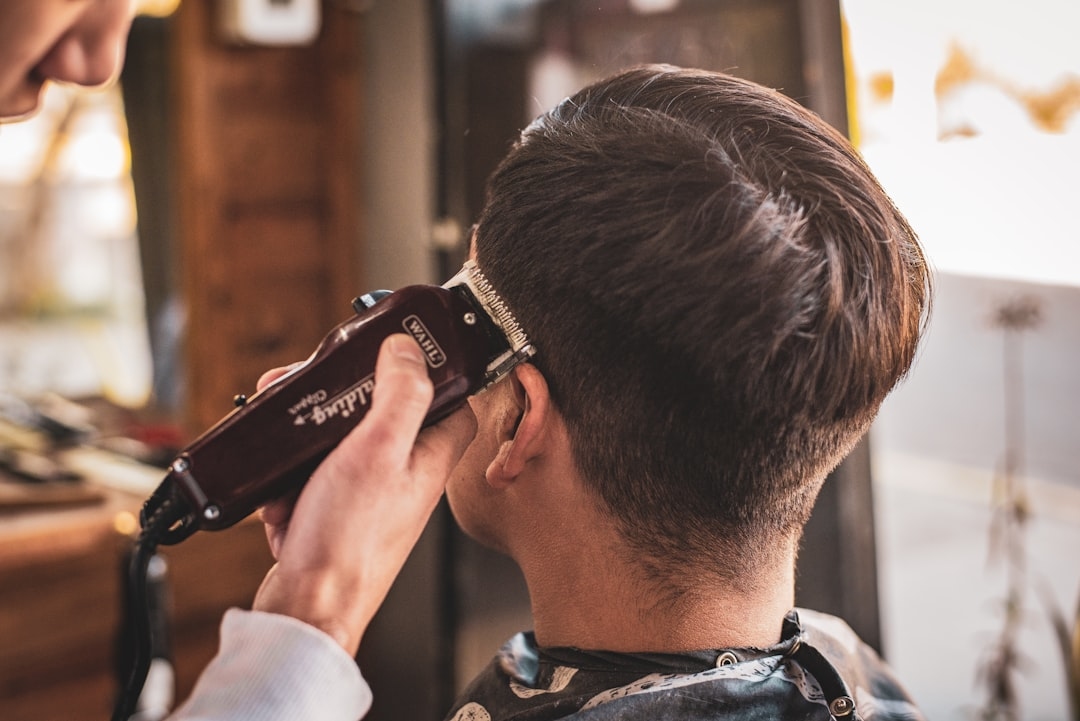
Pull your ear forward slightly with your non-clipping hand to expose the skin behind it. Use your smallest guard and follow the natural curve of your ear down to your jaw. Make two passes: one slightly above where you want the final line, then one final precise pass. This prevents over-cutting. The area directly behind the ear is particularly easy to hack, so slow down here.
The Neck Edge
Some men fade completely to the skin at the back of the neck; others leave a slight length. Either way, create a smooth, curved line following your natural neck shape. Use your smallest guard and make gentle upward passes from the collar bone toward the top of your neck. Avoid hard lines; hair naturally follows curves, and your cut should too. Two or three careful passes beat one aggressive one.
Sideburns
These should sit at the middle of your ear. Use scissors for control here — clippers often over-cut. If your sideburns are long, use scissors to trim them to roughly 12-15mm, then carefully clean up the edges with your smallest guard. Match both sides by regularly checking them against each other using a mirror.
Practical Tips for First-Time Cutters
Go Slightly Longer Than You Think You Need
Hair shrinks slightly once you finish and let it settle. What feels very short immediately after cutting will feel normal within 24 hours. On your first cut, use guard sizes one step larger than you think you want, then reassess. You can always cut shorter next time.
Never Cut Your Fringe (Front Hair) with Clippers
The front is too visible and clippers are too aggressive for fine detail work. If you want to adjust your fringe, use scissors and cut at a slight diagonal to create texture rather than a blunt line. Most men just let their barber handle the front while cutting the sides at home — there’s no shame in this hybrid approach.
Learn One Style Thoroughly Before Experimenting
Master the medium fade. Once you can consistently cut it well, branch out to tighter fades, high fades, or other variations. Jumping between styles on your first five cuts leads to confusion and frustration.
Keep Your Tools Clean
Hair clogs clippers. After each cutting section, tap the guard against the sink to dislodge loose hair. Every three months, open the guard and clean inside with an old toothbrush. Oil your clippers monthly with the oil they came with (or mineral oil). Dull blades tug rather than cut, which is uncomfortable and looks awful. Sharp clippers cost money; dull ones cost your dignity.
Build a Backup Plan
Keep your barber’s number handy. If your first cut goes genuinely wrong, a professional can usually salvage it by buzzing everything shorter and starting fresh. It’s not ideal, but it’s better than walking around looking like you’ve been attacked by a hedge trimmer. Most barbers are sympathetic to home-cutting mishaps and won’t judge.
Seasonal Cutting Schedule for Year-Round Maintenance
In spring (March to May), men typically prefer shorter, fresher styles to match the season. Cut every four weeks and use slightly higher guards to enhance the new-season feeling. Summer (June to August) is when tighter fades and minimal-length styles shine. If you want low-maintenance summer hair, cut every three weeks and use lower guard numbers (number 1 and smaller). Autumn (September to November) suits slightly longer styles — number 2 or 3 on top. Monthly cuts work well here. Winter (December to February) is when longer hair and fuller styles come into favour. Cut every five to six weeks, letting your hair build slightly more texture and length.
The seasonal rhythm also accounts for natural hair growth and life rhythms. You’ll find your own cadence, but understanding that seasons influence styling preferences helps you feel more in control of your appearance year-round.
Troubleshooting Common Mistakes
Uneven Sides
The most common beginner error. This happens because you’re cutting at slightly different angles on each side, or you haven’t made enough passes. Solution: cut both sides using the exact same technique, same guard sizes, same number of passes. Use your handheld mirror to compare constantly. If one side is already shorter, use a smaller guard on the longer side to blend them. Accept that perfect symmetry is nearly impossible; barbers spend years perfecting it.
Lines That Show Where Guards Changed
Visible transition lines mean your guards didn’t blend smoothly. Make additional passes with the larger guard to feather the area where the smaller guard started. Feathering (overlapping guard transitions) is the key skill that separates amateur cuts from professional ones. Practice intentional blending rather than hard lines.
Hair Feeling Uncomfortable During Cutting
Clippers pulling rather than cutting means dull blades. Stop immediately and oil your clippers or switch to new ones. A dull blade ruins the experience and the cut. Sharp tools are a non-negotiable investment.
The Back Looking Hacked
You can’t see the back properly, so you’re operating somewhat blind. Add mirrors, add lighting, and slow down significantly in the back. Some men ask their partner or flatmate to verify the back while they cut, which is entirely reasonable. There’s no shame in a second set of eyes.
FAQ: Everything Else You’re Wondering
How Often Should I Cut My Own Hair?
Every three to six weeks, depending on your style and growth rate. Tighter fades need cutting more frequently (every three weeks); longer styles can go six weeks between cuts. Personal preference matters more than rules. Some men cut monthly by choice, even if they don’t strictly need it. How to cut your own hair men effectively means establishing a routine that fits your life.
Can I Cut Curly or Textured Hair at Home?
Yes, but it requires different technique. Curly hair looks much shorter when cut dry and much longer when wet. Always cut curly hair dry and account for significant shrinkage. Use scissors rather than clippers for greater control on curly textures. Many men with textured hair find the learning curve steeper but absolutely achievable with patience.
What If I Make a Serious Mistake?
Call your barber. Most can fix mistakes by cutting everything shorter and blending things out. It costs £15-20, which is less than you saved by not paying them for a regular cut. Learn from the mistake and try again in four weeks when it’s grown back slightly. Everyone cuts themselves badly once — it’s not the end of the world.
Can I Cut My Hair While It’s Wet?
Not recommended. Wet hair is deceptively longer due to being weighed down. You’ll consistently cut 5-10mm shorter than intended. Always cut dry, fully dried hair in its natural state. This is non-negotiable for consistent results.
How Much Money Will I Save?
If you’re currently paying £25 per cut and cutting every six weeks, you’re spending £200 annually. You’ll save roughly £150-180 per year after accounting for tool maintenance and replacement clippers every three to five years. Over a decade, that’s £1,500-1,800 in savings. More importantly, you’ll gain control over your appearance and never wait for a barber appointment again.
Your New Grooming Reality
Learning how to cut your own hair men is learning that you’re more capable than you believed. The first cut will feel awkward. The second cut will be noticeably better. By the fifth cut, you’ll stop thinking about technique and start thinking about style. By the tenth cut, you’ll look in the mirror and forget that you cut it yourself — you’ll just see a well-groomed person looking back.
The barrier isn’t ability; it’s confidence. Every skilled barber started exactly where you are now, clippers in hand, looking at their own head in the mirror wondering what on earth they were doing. The difference is they persisted through awkwardness and became experts. You don’t need to become an expert — you just need to be good enough for yourself, in your own bathroom, on your own schedule.
Start this week. Buy decent clippers, set up proper lighting, and commit to two cuts before you assess results. You’ll discover that barbershop precision is learnable, not magical. More importantly, you’ll discover that grooming is a skill, not a service you pay for passively. That shift changes everything.